
Best Time Frame for Candlestick Patterns

Today, we look at the best time frame for candlestick patterns.
Candlestick patterns are popular because they are easy to see on a chart. They help traders visualize price action and spot potential turning points.
But visual appeal is not enough.

The real question is: do candlestick patterns actually work when tested?
To find out, we backtested three candlestick patterns on SPY, the ETF that tracks the S&P 500:
Bearish Engulfing Pattern
Three Outside Down Pattern
Bullish Harami
The strategy enters when one of these patterns appears. The exit is when today’s close is above yesterday’s high.
We tested the same idea on different time frames. In this article, we focus on the daily and weekly results.
Daily Candlestick Backtest
The daily time frame produced the best results.
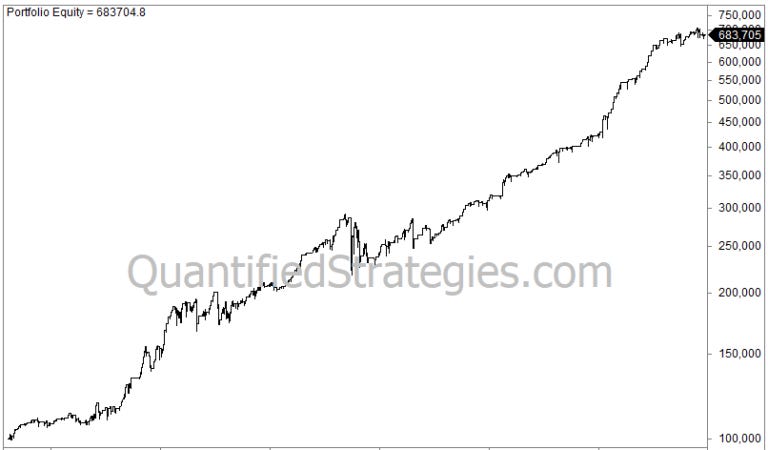
The backtest returned:
474 trades
0.43% average gain per trade
73% win rate
Profit factor of 2.1
CAGR of 6.2%
Time in the market: 20%
Max drawdown: 25%
These are decent numbers for such simple rules.
The most interesting part is the time spent in the market. The strategy was only invested 20% of the time, yet it still produced a reasonable CAGR.
This suggests that daily candlestick patterns may be useful for short-term stock market strategies, especially when the holding period is only a few days.
Weekly Candlestick Backtest
The weekly version was much weaker.
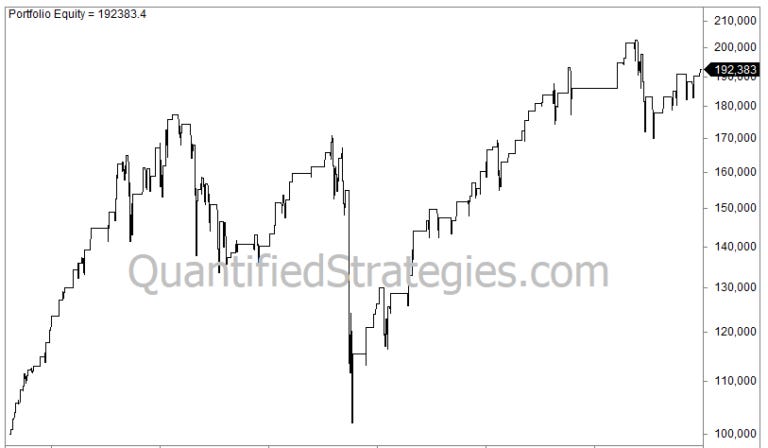
The backtest returned:
105 trades
0.7% average gain per trade
73% win rate
Profit factor of 1.5
CAGR of 2.1%
Time in the market: 24%
At first glance, the weekly version does not look terrible. The win rate is the same as the daily version, and the average gain per trade is higher.
But the problem is the lower number of trades and the weaker equity curve.
The CAGR drops from 6.2% on daily bars to only 2.1% on weekly bars. The profit factor also falls from 2.1 to 1.5.
This makes the weekly time frame much less attractive.
Daily vs. Weekly: The Main Lesson
The daily time frame gave more trades, better CAGR, and a higher profit factor.
The weekly time frame gave fewer signals and a weaker long-term result.
This is a good reminder that a pattern can look logical on a chart but still perform very differently depending on the time frame.
For candlestick patterns, our backtest suggests that daily bars work better than weekly bars.
Conclusion
Candlestick patterns appear to work best on daily bars with short holding periods.
Weekly bars produced fewer trades and weaker returns, while daily bars gave a better balance between signal frequency, profitability, and time in the market.
Based on this test, the daily time frame seems to be the best choice for candlestick trading strategies in the U.S. stock market.