
Multi-Timeframe Analysis And Strategy
Backtest And Results

Multi-timeframe analysis and strategy is a trading approach where the same asset is analyzed across different time horizons to improve decision-making.
The concept is straightforward: a higher timeframe is used to determine the overall market direction, while a lower timeframe is used to optimize entries and exits.
In practice, the higher timeframe answers what to trade, while the lower timeframe answers when to trade.
Traders often structure their analysis using a ratio between timeframes, such as analyzing the daily chart for trend and a shorter timeframe like the 4-hour or 1-hour chart for execution.
This top-down approach helps ensure that trades are aligned with the broader market context rather than reacting to short-term noise.
Why Multi-Timeframe Analysis Works
The strength of multi-timeframe analysis lies in its ability to filter trades. By focusing only on setups that align with the dominant trend, traders naturally avoid many low-probability situations. Instead of reacting to every signal, the strategy forces selectivity.
This filtering effect often results in fewer trades, but the trades that are taken tend to be more consistent. It also reduces emotional decision-making by providing a clear structure for both context and execution.
Multi-Timeframe Trading Strategy Rules
The strategy presented in our original article on our website follows a simple but effective structure. You’ll find the backtest further below in the article.
A higher timeframe trend filter is first established, typically using a moving average or similar indicator to define whether the market is in an uptrend or downtrend.
Once the trend is identified, the strategy shifts to a lower timeframe to look for entry signals that align with that trend.
Entries are taken only when the lower timeframe confirms the direction suggested by the higher timeframe. Exits are then triggered either by a reversal signal on the lower timeframe or by predefined rules designed to protect capital and lock in gains.
This combination creates a disciplined system where every trade is supported by both context and timing.
Backtest Results of the Multi-Timeframe Strategy
We made the following trading rules and backtested it on XLP, the ETF that tracks the consumer staples:
We use a long-term trend filter: The close must be higher than the close 250 days ago.
We use an intermediate trend filter: The close must be higher than the close 22 days ago.
We use a short-term pullback: The close today must be a three-day low (of the close).
If 1, 2, and 3 are true, then go long at the close.
We sell at the close when the close is higher than yesterday’s close.
Equity Curve Analysis: What the Backtest Reveals
The trading statistics and performance metrics are solid and reflect a robust strategy. The backtest includes a total of 316 trades, providing a meaningful sample size.
The average gain per trade comes in at 0.28%, which may seem modest, but compounds effectively over time. The strategy achieves a win rate of 73%, indicating that a large majority of trades are profitable.
Risk is kept under control, with a maximum drawdown of 10%, which is relatively moderate for a systematic trading strategy.
In addition, the profit factor is 2, meaning that total profits are twice as large as total losses. Together, these metrics suggest a strategy that combines consistency with controlled risk, which is often a hallmark of durable trading systems.
The equity curve from the backtest provides deeper insight into how the strategy behaves:
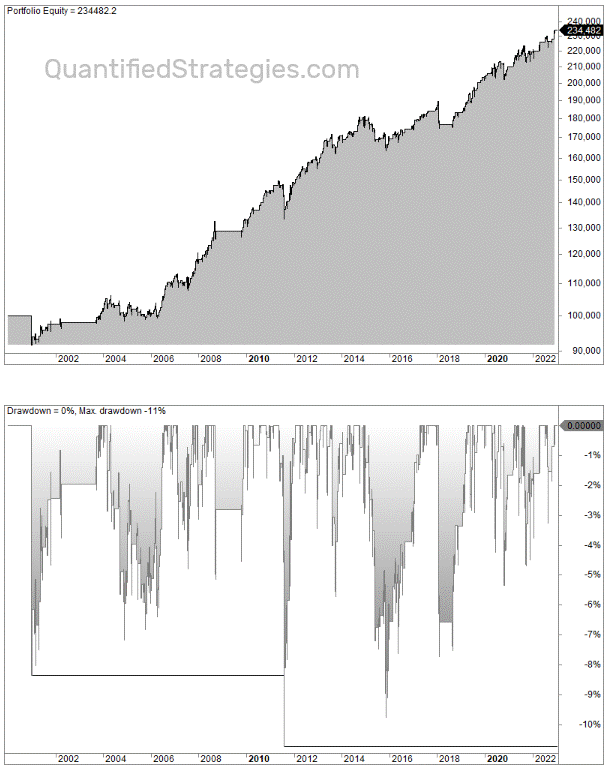
It shows a steady upward progression, reflecting consistent gains over time rather than reliance on a few large trades.
There are periods where the curve moves sideways, which typically occur during choppy or trendless markets. During these phases, the higher timeframe filter keeps the strategy out of many trades, preserving capital. When clear trends emerge, the equity curve resumes its upward trajectory.
Importantly, the drawdowns appear moderate and contained, which suggests that the strategy manages risk effectively. This smoother equity curve is one of the main advantages of incorporating multiple timeframes into a trading system.
Pros and Cons of Multi-Timeframe Analysis
Multi-timeframe analysis improves trade selection by aligning entries with the dominant trend and reducing noise from lower timeframes. It also provides a structured decision-making framework that can enhance consistency.
However, the approach introduces additional complexity, as traders must monitor multiple charts and ensure that signals are properly aligned. There is also a risk of over-optimization when combining different timeframes, as too many parameters can be added.
Final Thoughts on Multi-Timeframe Trading
Multi-timeframe analysis is not a standalone edge, but it is a powerful framework for improving existing strategies. By combining a broader perspective with precise timing, it helps traders focus on higher-probability opportunities while avoiding many common pitfalls.
The backtest and equity curve clearly illustrate that this approach can lead to more stable performance and better risk control when applied systematically.
Multi-Timeframe Analysis and strategy is ultimately about aligning the big picture with execution, and that alignment is often where more robust and consistent trading performance begins.