
The Ultimo Effect In Stocks

Today, we look at the Ultimo Effect in stocks.
In simple terms, the Ultimo effect is the tendency for markets to drift higher at the very end of the month and into the first few trading days of the next one. It’s not a rule, but it shows up often enough to make you pay attention.
What’s interesting is that it has very little to do with news or fundamentals. It’s mostly about money flows and rebalancing. Pension contributions come in, funds rebalance, and managers put cash to work. There’s probably also a bit of psychology, no one wants to show up to a monthly report holding too much cash or lagging positions.
Over time, I’ve learned not to treat this as a “strategy” on its own. It’s more like a tailwind. If I’m already leaning bullish, and we’re approaching month-end, I’m a bit more confident holding risk. If I’m bearish, I’m aware that the market might push against me temporarily.
The Ultimo Effect in stocks is a great starting point for developing strategies, not only in stocks but also in bonds.
The Ultimo Effect In Stocks - Backtest
Let’s backtest the Ultimo Effect in stocks (S&P 500):
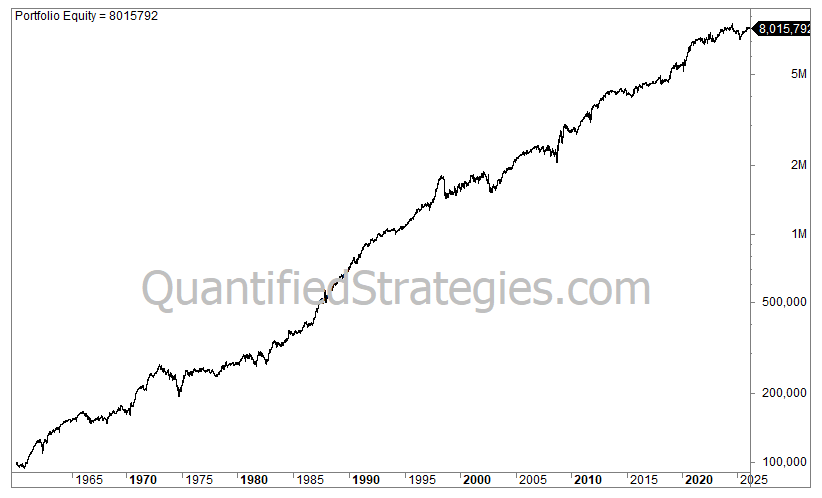
Performance
No. of trades: 794
Average gain per trade: 0.6%
Win ratio: 61%
Profit factor: 1.7
Annual returns (CAGR): 6.8%
Exposure/time in the market: 33%
Risk-adjusted return: 20% (CAGR divided by time spent in the market (0.33))
Max drawdown: -27%
Trading Rules
We go long at the close on the fifth last trading day of the month, and we exit after seven days, ie, at the close of the third trading day of the next month.