
Volume Trading Strategy

Today, we look at a volume trading strategy.
Most mean reversion strategies start with price.
A market falls too much, too fast. It stretches away from its short-term average. It closes down several days in a row. The idea is simple: when selling becomes excessive, the odds of a bounce may improve.
But price is only one part of the story.

Volume can add another layer.
Volume tells us something about participation. Was the move quiet and random, or did it happen with unusual activity? Was there panic selling? Was there forced liquidation? Did buyers or sellers suddenly become much more active than normal?
That might matter because two price moves that look the same on a chart may not mean the same thing.
A 2% drop on normal volume may simply be noise. A 2% drop on extremely high volume may signal capitulation, stress, or a short-term imbalance. Sometimes, those are exactly the conditions where mean reversion works best.
That extra information may make volume a useful diversifier inside a portfolio of mean reversion strategies.
Volume Trading Strategy
We backtest, of course, and we got the following results for SPY (after slippage and commissions of 0.03% per trade):
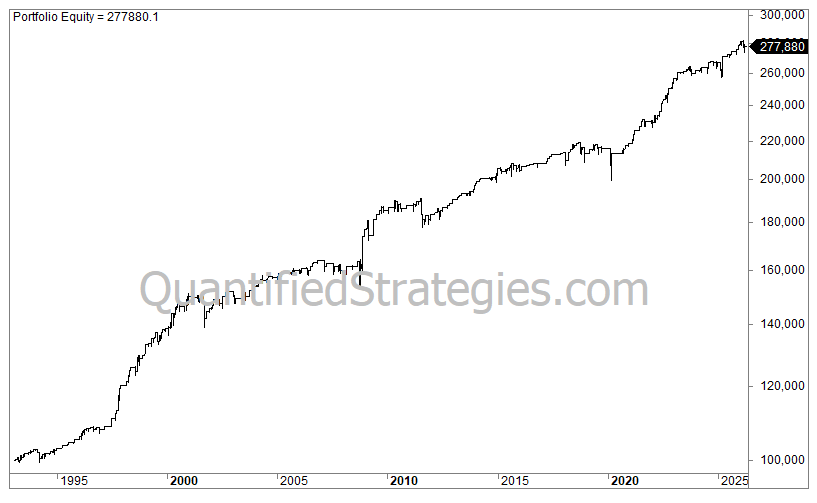
Strategy type: Volume strategy.
Market: SPY (S&P 500).
Performance
No. of trades: 361
Average gain per trade: 0.6%
Win ratio: 75%
Profit factor: 2.2
Annual returns (CAGR): 3.1%
Exposure/time in the market: 7%
Risk-adjusted return: 42% (CAGR divided by time spent in the market (0.07))
Max drawdown: 9%
Trading Rules
We backtested the following trading rules: