
Why Your Trading Strategy Needs a Statistical Edge

Many traders spend years obsessing over mindset and risk management. While these are important, they are often used as a distraction from a harsher reality:
If your strategy lacks a statistical edge (positive expectancy), you probably won’t make money regardless of position sizing or how disciplined you are.
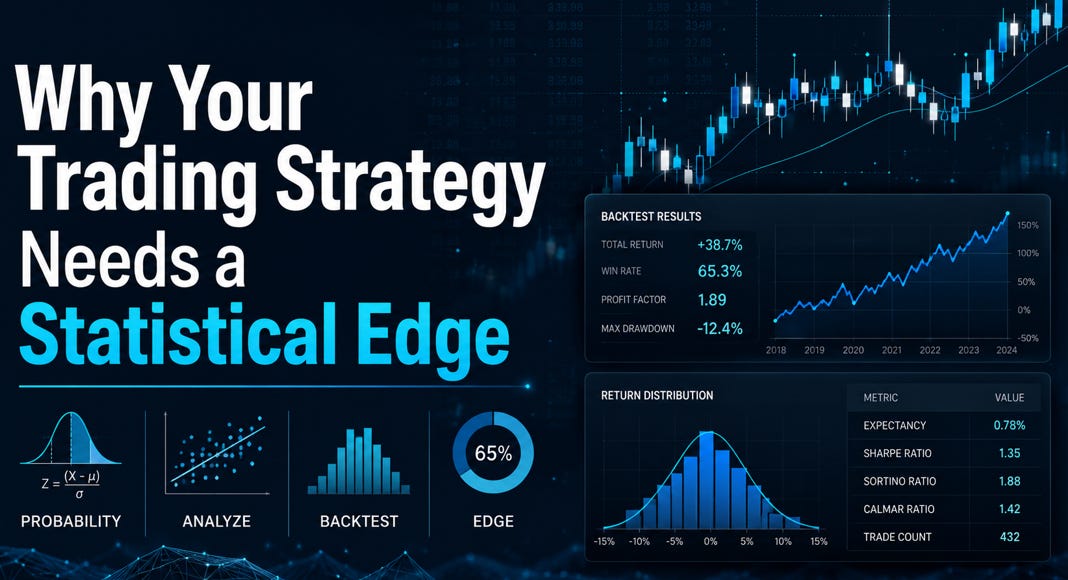
Data Over Hope
The most successful traders share a common trait (at least the traders we have come across): they don’t rely on hope; they rely on data.
In a market driven by uncertainty, hope is a liability. By shifting your focus to data-driven decision-making, you move away from emotional guesswork and toward a more systematic approach to the markets.
The True Purpose of Backtesting
To find this data, you must backtest everything. It is a common misconception that backtesting is a tool for predicting the future.
In reality, its purpose is to prove that a strategy actually worked over time. It provides the historical evidence needed to trust your process when the market gets volatile.
The Two Pillars of Profitability
According to the data, a profitable trader essentially needs three things:
A strategy with positive expectancy: A proven statistical advantage that ensures, over a large enough sample size, the strategy is profitable.
The discipline to follow it: Even the best strategy is worthless if you lack the discipline to execute it consistently.
The position size to avoid ruin: even with a positive expectancy, you can lose it all if you trade too aggressively. Always trade smaller than you would like!
Conclusion
Stop guessing and start testing. Your success in trading isn’t about being “right” on the next trade; it’s about having the statistical edge to be right over the next hundred (and survive).